Project Overview
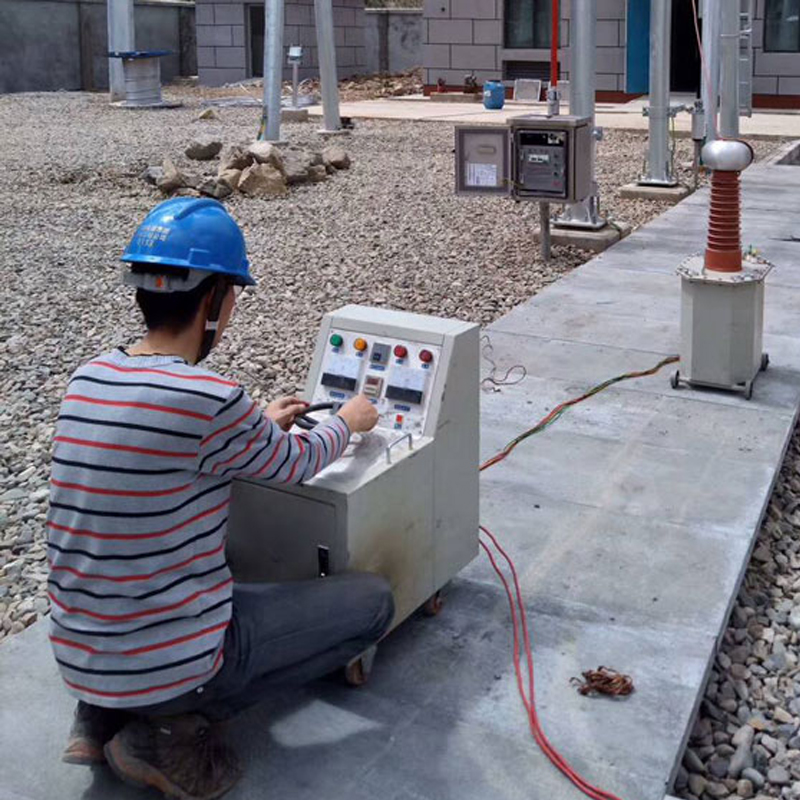
As a key part of the installation and acceptance testing for the Hohhot Substation project in Inner Mongolia, the VINDAION engineering team successfully completed the power frequency withstand voltage test on the core high-voltage equipment at the station. The test aimed to verify the ability of the equipment’s insulation system to withstand extreme electrical stress, ensure long-term operational safety, and fully complied with the relevant standards and requirements of the State Grid of China.
Purpose of the Test
The power frequency withstand voltage test is one of the most rigorous and important inspection items for high-voltage electrical equipment. Its core objectives include:
First, verifying insulation strength. By applying a 50Hz AC voltage much higher than the rated operating voltage of the equipment, it is confirmed that the main insulation (windings, bushings, support structures) can withstand transient overvoltages during service.
Second, identifying hidden defects. It detects potential problems such as manufacturing flaws, transportation damage, moisture ingress, or surface contamination, preventing major faults such as insulation breakdown during normal operation of the equipment.
Third, ensuring compliance. The test meets the requirements of standards including DL/T 596-2021 Preventive Test Code for Electric Power Equipment and GB/T 311.1 Insulation Coordination, ensuring the equipment can be safely connected to the Inner Mongolia power grid for operation.
Test Execution and Procedure
The team strictly followed a standardized, safety-first test process to efficiently complete on-site operations:
Pre-Test Preparation
The test area was equipped with safety barriers and "High Voltage Danger" warning signs, and the control console and test transformer were reliably grounded to eliminate stray voltage risks. All test instruments had completed metrological calibration, and on-site temperature and humidity were monitored simultaneously to ensure they met the environmental conditions for high-voltage testing. Before applying high voltage, an insulation resistance test was conducted to establish a baseline value, confirming that the equipment had no obvious insulation defects.
Wiring and Verification
The high-voltage output terminal of the VINDAION test system was reliably connected to the Equipment Under Test (EUT), and non-tested phases and the equipment casing were safely grounded. All wiring was double-checked by senior engineers to eliminate the risk of short circuits or incorrect connections.
The Test Process
Before the test, the voltage regulator on the control console was reset to zero, and then the test system was started. The voltage was slowly increased to the specified test voltage at a stable rate of 1-2kV/s, with real-time monitoring of voltage, current, and equipment status throughout the process. After reaching the target test voltage, the voltage was maintained for 60 seconds in accordance with standards. During this period, engineers continuously observed the Equipment Under Test to check for abnormalities such as discharge, flashover, or abnormal noise. At the end of the voltage hold period, the voltage was smoothly reduced to zero; a dedicated discharge rod was used to fully discharge the test system and the Equipment Under Test, and wiring was removed only after confirming there was no residual voltage.
Core Advantages of the VINDAION Test System
The VINDAION power frequency withstand voltage test system used at the site provided key support for the project:
It delivers stable output and high-quality waveforms. Even under the complex on-site conditions of the substation, it can output a standard sinusoidal voltage without distortion, ensuring accurate test conditions. It is equipped with comprehensive safety interlocks, including overvoltage, overcurrent, and zero-start protection mechanisms, providing dual safety protection for test personnel and the Equipment Under Test. Designed specifically for on-site operations, the compact structure can be flexibly deployed in outdoor substations, with good dustproof and temperature-resistant performance to adapt to complex on-site working conditions.
Project Conclusion
The power frequency withstand voltage test at the Hohhot Substation has been successfully completed, and all tested equipment has passed the standard assessment. This marks another milestone for VINDAION in supporting the safe and stable operation of China’s power infrastructure. The team’s strict adherence to test procedures, combined with the reliable performance of VINDAION test equipment, has laid a solid foundation for the long-term safe operation of the substation.